Amazing Link Medusa — review
Hold & Win bonus
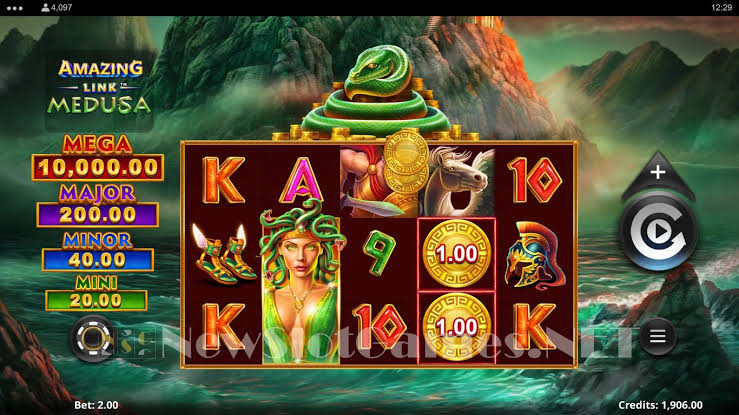
Landing six or more Medusa-cash tiles anywhere on the reels drops the base game and opens the Hold&Win bonus round on a dedicated grid. You start with three respins. Every fresh Medusa-cash tile that lands resets the respin counter back to three. Each cash tile carries a printed C$ value scaling with stake (from 1x to 50x at the low tier, up to a 500x showpiece tile at max bet), and the four fixed jackpot values sit above the grid: Mini 20x, Minor 50x, Major 500x, Grand 5,000x.
The bonus ends one of two ways — the respin counter runs to zero, or the entire 15-cell grid fills. A full grid awards the Grand jackpot at 5,000x stake on top of every cash value already collected. At the minimum C$0.20 spin that is a C$1,000 pay-out; at C$5 per spin it is a C$25,000 hit. The Major, Minor and Mini jackpots print as static C$-value tiles that can land at any point during the respin sequence rather than being awarded by grid-fill logic.
Base-game hit frequency for the Hold&Win trigger sits at roughly 1 in 180 spins on average, in line with the wider Amazing Link series. Because the entire return-to-player is concentrated inside these bonus rounds, treat every trigger as a genuine event — do not autopilot the respins.
Free spins and Freezing Wilds
The second bonus route is triggered by three Medusa-portrait scatters, which fires 15 free spins on the standard 5×3 board. During the free-spin round, any wild that lands turns into a Freezing Wild — it stays locked in position for the remainder of the round and expands the wild coverage spin by spin. There is no multiplier ladder on Freezing Wilds themselves; the RTP contribution comes from the sheer coverage they build across the reels as the round progresses.
Retriggers are possible — three more scatters land another 15 spins on top — and any Medusa-cash tiles that show up during the free-spin round drop straight into the Hold&Win bonus at the end, layered on top of the free-spin wins. Reaching the 5,000x cap most often comes from a long free-spin run that piles into a Hold&Win with the Grand jackpot at the top.
Strategy and bankroll
Base play on Amazing Link Medusa is deliberately dry — base-game hit frequency for any payout at all runs around 1 in 4 spins, most landing well under 1x your stake. The whole slot's RTP is engineered around the Hold&Win bonus, which arrives on average once every 180 base spins. A sensible session shape:
- Minimum bankroll: 200x your base bet (C$40 at the C$0.20 minimum) to absorb base-game variance
- Stake sizing: 0.5-1% of session bankroll per spin — resist ramping up during dry streaks
- Autoplay in 50-spin blocks with a loss-stop set at 30% of the session budget
- No Bonus Buy on this title — you have to grind the Hold&Win trigger through normal play
- If you hit the Hold&Win, drop autoplay and pay attention manually — the respin math genuinely matters
Mobile at Betty
The compact 5×3 board was purpose-built for portrait phone play — no forced landscape flip, no pinch-zoom. The Games Global HTML5 build weighs roughly 5 MB for full asset load, comfortably inside most Canadian mobile-data caps, and the Hold&Win animation stays at a stable 60fps on any handset from 2020 onwards including budget Android. Our mobile site launches the game directly with no App Store or Google Play download required.
Battery drain runs about 5-8% per hour of continuous spins on iPhone 12+ or comparable Android hardware — the snake-scale backdrop is a looped video track rather than a per-frame particle simulation. The Hold&Win entry audio cue sits loud on default; dropping the in-game volume to around 40% is worth it for longer sessions on speaker.
Medusa vs Amazing Link Zeus — differences
Both slots share the same Amazing Link Hold&Win engine but the maths sits a step apart. Amazing Link Medusa publishes an RTP of 96.02% versus 95.02% on Amazing Link Zeus, so on paper Medusa returns roughly 1% more of long-run stake volume. The jackpot ladder is identical (Mini 20x, Minor 50x, Major 500x, Grand 5,000x), and the trigger requirement is the same six Medusa-cash tiles.
The main functional difference is the free-spin layer: Zeus runs a lightning-multiplier ladder instead of Freezing Wilds. If you value the base-game feature route, Zeus is the more active pick; if you want the higher headline RTP and the wild-coverage build that Medusa offers, this title is mathematically the stronger of the two.
 B
B 🐍
🐍
 BIGGER
 CAISHEN
 DRAGON
 WISH
WISH GOLDEN
 PIGGY
PIGGY