Chicken Road — review
Three risk modes
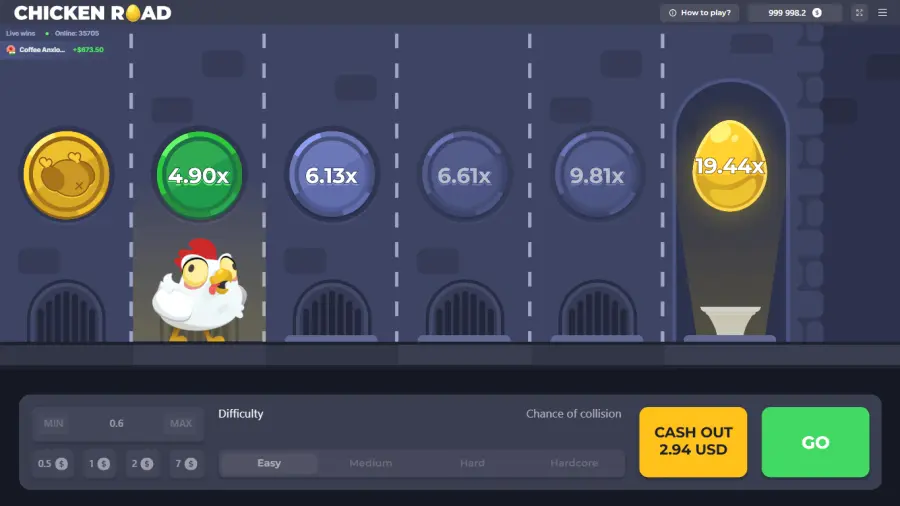
Chicken Road opens on a mode selector before every round: Easy, Medium, or Hard. Easy runs a wide, forgiving curve with hits between 1x and 3x landing frequently — roughly 45% of Easy rounds cash out under 1.8x on our data, which stretches a small bankroll while the multiplier bar climbs. Medium widens the payout window and shifts the balance point higher, with the sweet spot for cash-outs falling between 2x and 10x.
Hard mode is where the ceiling lives. Payouts rare — well under one Hard round in six lands anything — but the tail reaches the full 3x to 500x band, and the game's overall 20,000x cap sits at the top end of Hard-mode play. Because all three modes settle at the same 98.00% RTP over the long run, the choice is purely about variance shape: Easy for session length, Hard for the deep-tail hunt.
Unlike the 2024 sequel, mode-hopping mid-session is the whole toolkit here. We've had regulars build entire sessions around a rhythm of eight Easy rounds followed by one Hard swing — a discipline that funds the Hard hunt with the Easy cash-outs and locks in the win the moment a 100x+ Hard round lands.
Manual and auto cash-out
The interface keeps things minimal. A manual cash-out button dominates the middle of the screen — press it any time between round start and the crash, and you bank whatever multiplier is showing. There's no partial cash-out (that's a Chicken Road 2 addition); the button locks in your full stake at the current multiplier or nothing at all.
The auto cash-out field, top-right of the crash panel, lets you preset a target multiplier — type 2.00 and the round self-locks at 2.00x every time you'd cross that line. For Easy mode we suggest 1.5x to 2.2x; for Medium 3x to 5x; for Hard leave it open above 10x and take the wait. Both cash-out methods are available in demo, so it's worth testing preset ranges before wagering any C$.
Strategy
Chicken Road rewards session discipline. Because there's no bonus-round tail to chase, the game is fundamentally about stake sizing and stop-loss thresholds. A sensible shape at Betty:
- Session bankroll: 150x your base stake (C$15 at the C$0.10 minimum) — enough to survive a Hard cold streak
- Stake sizing: 0.5-1% of the bankroll per round; don't ramp up after a loss
- Auto cash-out preset: 2x on Easy, 3x-5x on Medium, open target on Hard
- Mode discipline: cool down to Easy after any 100x+ Hard cash-out
- Session loss-stop: 30% of the session bankroll walks away
Because our welcome-bonus rollover caps stake at C$5, we suggest Medium mode with auto cash-out at 3.00x for wagering runs — predictable clearance while keeping enough tail for the odd 50x cash-out to help the rollover along.
Mobile
The 2023 build defaults to a landscape layout, which is a small friction on iPhone — the cross-lanes grid needs the horizontal width to breathe. Once flipped, the cash-out button sits under the thumb and the multiplier readout stays legible even on smaller 5.5″ screens. Full HTML5 asset pack weighs around 2.5 MB, so a session from Canadian mobile data is cheap in bytes.
Interac e-Transfer top-ups settle in around 30 seconds from your phone while a Chicken Road round runs. Battery drain sits at roughly 3-5% per hour of continuous play — noticeably lower than a video slot because there are no spinning-reel particle systems to render. Landscape lock in browser settings is worth turning on if you're playing more than a handful of rounds.
Chicken Road vs Chicken Road 2 — differences
The 2024 sequel is a superset with the same core. Chicken Road holds a shared 98.00% RTP and three risk modes; Chicken Road 2 keeps the RTP identical but adds a fourth Extra Hard mode that lifts the ceiling from 20,000x to 25,000x. The sequel also adds random powerups (×2 multiplier or bonus coins) roughly once every twelve rounds, plus a 50% partial cash-out that the original doesn't include.
UI-wise the original defaults to landscape whereas the sequel is portrait-first for phones. If you want the cleaner, more predictable crash rhythm with no mid-round randomness, stay on the original Chicken Road — it's mathematically the same on the shared Easy/Medium/Hard modes and easier to strategise around. If you want the higher ceiling and the hedging tools, jump to Chicken Road 2.
 B
B 🐔
🐔
 CHICKEN
 DRAGON
 BIGGER
 AMAZING
 CAISHEN
 WISH
WISH