Chicken Road 2 — review
Risk modes explained
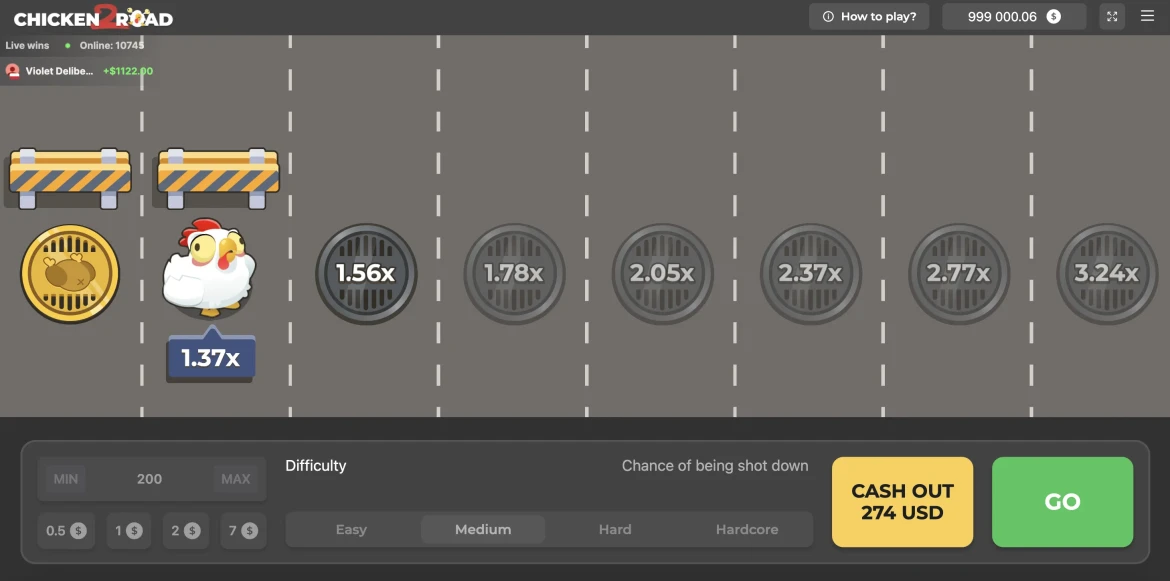
The core add-on over the 2023 original is a fourth risk band. You now pick from Easy, Medium, Hard, or Extra Hard before every round, and the choice re-weights the underlying crash curve. Easy sits on a wide multiplier ladder from 1.02x upwards with a crash frequency of roughly one round in three landing under 2x — ideal to lengthen a session at the C$0.10 minimum. Medium widens the payout window to a soft cap around 200x with proportionally shorter runs.
Hard mode compresses low-multiplier hits and pushes the tail out to 3,000x, while Extra Hard — new for the sequel — unlocks the full 25,000x ceiling but crashes under 1.5x on more than 60% of rounds. Because the mode switch happens per round rather than per session, you can rotate: cool down on Easy after a losing streak, ramp back to Hard when the bankroll allows. Every mode still returns to 98.00% over the long run — the RTP is shared, only the variance shape changes.
Cross-mode play is where Chicken Road 2 rewards attention. Sticking on Extra Hard drains a small bankroll in twenty rounds; alternating with Easy protects the base stake while leaving room for the occasional deep-tail chase. We've had regular players report Extra Hard hits from 800x to 4,200x in ordinary sessions.
Powerups and partial cash-out
Two features are new to the sequel. Random powerups drop mid-round on roughly one round in twelve: a ×2 multiplier boost that doubles the current running figure, or a bonus-coin drop worth 5-20x your stake awarded immediately without needing to cash out. Powerups can't be bought — they trigger algorithmically inside the round.
The partial cash-out button is the other headline addition. At any point mid-round you can lock in 50% of your stake at the current multiplier while letting the remaining 50% ride on for a larger tail. Used well, it turns a 12x cash-out into a guaranteed 6x plus a free swing at a 100x-plus finish — a strong hedge on Hard and Extra Hard modes where the ceiling justifies the risk. Manual cash-out and auto cash-out at a preset multiplier both still work as in the original.
Strategy
Chicken Road 2 rewards discipline more than the original because the powerups introduce short-term variance spikes. A sensible session shape at Betty:
- Session bankroll: 200x your base stake (C$20 at the C$0.10 minimum) to survive Extra Hard cold streaks
- Stake sizing: 0.5-1% of the bankroll per round; do not chase after two crashes
- Auto cash-out preset: 1.8x-2.5x on Easy/Medium, or 10x+ on Hard/Extra Hard
- Partial cash-out: use it from 6x onwards on Hard, from 15x on Extra Hard
- Rotate modes: cool down to Easy after any 500x+ cash-out to lock the win
Because our welcome-bonus rollover caps stake at C$5, we recommend Medium mode for wagering runs — the shorter tail improves the odds of clearing the rollover before variance eats the bankroll. Save Extra Hard for real-money play only.
Mobile
The no-reels layout was rebuilt for portrait phone play in the 2024 release. The chicken-hop grid stays vertical, cash-out button sits under the thumb, and the powerup pop-ups occupy the top third rather than obscuring the multiplier readout. The full HTML5 asset pack weighs about 3 MB — well inside any Canadian mobile-data ceiling — and the crash animation runs at 60fps on iPhone 11 and later plus mid-range Android from 2021 onwards.
Interac e-Transfer top-ups process from your phone in around 30 seconds while a round is running, so you can add C$20 mid-session without missing a hop. Battery drain sits around 4-6% per hour of continuous play — lower than a video slot because there's no reel-spin particle system to render.
Chicken Road 2 vs Chicken Road — differences
Same base engine, four material changes. First, the sequel adds Extra Hard mode alongside the original's Easy/Medium/Hard trio, lifting the maximum win from 20,000x to 25,000x. Second, random powerups (×2 multiplier or bonus coins) fire inside the sequel roughly once every twelve rounds — the original has none. Third, partial cash-out at 50% is exclusive to the sequel; the original only offers full cash-out. Fourth, the sequel's UI is portrait-first for mobile whereas the 2023 build defaults to landscape.
RTP is identical at 98.00% on both games, and the underlying crash-curve maths on the shared Easy/Medium/Hard modes match. If you liked the original's rhythm and don't want the powerup randomness, stay on Chicken Road. If you want the higher ceiling and the hedging options, Chicken Road 2 is the mathematically stronger pick.
 B
B 🐔
🐔
 CHICKEN
 DRAGON
 BIGGER
 AMAZING
 CAISHEN
 WISH
WISH